
Into Summer with Emily Dickinson
reading, being uncertain, letting go

This essay was originally commissioned by Disability Arts Online. This version has been slightly amended from that originally posted there in 2022, though I have avoided changing it too much, so it still shows where I was at that time. Nothing substantive has been deleted, slight corrections and some clarifications have been made (including adding the subtitle).
Since writing the essay I have read through her poems completely and continue to do so, starting to turn now to more of her letters than I had. It’s a slow process and I limit myself to one of her poems per day, usually.
Into Summer with Emily Dickinson
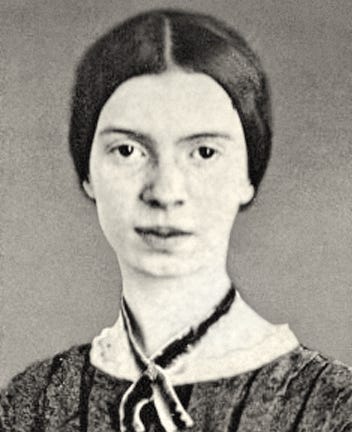
Daguerreotype of the poet Emily Dickinson, taken circa 1848. (Restored version.) From the Todd-Bingham Picture Collection and Family Papers, Yale University Manuscripts & Archives Digital Images Database, Yale University, New Haven, Connecticut. Public Domain via Wikimedia Commons, cropped and blown up.
It’s all I have to bring today –
This, and my heart beside –
This, and my heart, and all the fields –
And all the meadows wide –
Be sure you count – sh’d I forget
Someone the sum could tell –
This, and my heart, and all the Bees
Which in the Clover dwell.
Emily Dickinson (from fascicle 1, Franklin 17)
How beautiful.
If I were wise I might leave my comments there. But Emily Dickinson spoke on other days too, of this and more. I always noticed this poem, whenever it was I first read it. It makes me feel l have summer inside me. The poem is ‘This’, and I wonder if I only realised when I looked at it again that in a way it is its own poetics, a simple presence of heart with the world – that opens up the whole world, imposes nothing on it beyond that presence, and gains a world at heart. What a gift to share.
It helps me feel I can begin to write this now.
In the first Lockdown in 2020 I’d just left a stay in hospital. In some ways Lockdown helped me return to the world. The dreaded meds were of course higher than I might like. But I realised in the domesticity of that time and relief from the norm that it might be a good time to try reading more Emily Dickinson. I felt like it. I wanted to read her in that peace (as long as Covid stayed away), and of course I thought about her own domesticity as I did. I realise how much so many others were affected terribly differently in that time. It occurs to me now how keenly aware of death Emily Dickinson was in so much of her writing.
I’d read many of her poems before individually, a selected poems, and several hundred from the start of both Johnson’s and Franklin’s editions before losing my way. Those editions gave me a craving to read the poems by Fascicle (the little booklets she sewed sheets of her handwritten poems into), as far as possible and as close to how she presented them as I could. And so, I’d discovered at some stage Emily Dickinson’s Poems as She Preserved Them edited by Cristianne Miller, and had been able to get a copy when I was working. I got my head down.
I was nearing the end of the Fascicles when I agreed to write an essay on Emily Dickinson and a blog article about the process. We agreed I’d try to be quick about it. I pressed on enthused, beyond the Fascicles and into the loose sheets. I got fifty sheets into those sheets, there are ninety-eight of them and then loose poems and more beyond, and I lost my way. Lockdown had ended, life’s rhythm changed. Perhaps I was trying a bit too hard and with an article to think about had too much in mind.
After my previous attempts at Johnson’s and also Franklin’s collections of her poetry I’d decided that to get further it would be necessary to keep turning back to swim in the sea of Emily Dickinson’s poems, not reach for the side or need to place feet on sand. Once again it seems exactly what I lost the knack of doing. I might wonder if I had used up all my ‘negative capability’ to follow John Keats, replacing it with my pictures of Emily Dickinson.
I was certainly busy building up my ideas on countless fronts that I can never wholly reflect in any essay, they’d be a life’s work. She is so rich to read. Yes, I think this is it – and this may apply to other reading, after a while ‘negative capability’ can be challenged and I am no longer, or less “capable of being in uncertainties, Mysteries, doubts, without any irritable reaching after fact & reason”, I stopped letting her obliterate “all consideration” with her beauty – oh sad, how sad (John Keats, 1817).
I knew this even as I did it – yet did not escape it. So, it is nice to connect to Emily Dickinson herself eschewing her knowledge (except a deep wisdom) and being in such a glorious poem.
I’ve not really read her since then, just individual poems I came across. Though I have thought about her and I have read about her and I have tried to write this blog and the article several times – usually getting stodgy and stuck.
It’s only as I’ve written more poetry myself that I have really rebelled against the academic. I am quite negative about it these days – though I know at its best it is not stodgy nor as dead as it can seem. But it can be – and it can be if I don’t treat it like music, or maybe get lost in my own stodginess. I also need not to dwell on how I fear the academic can be a way to contain our freedom. When I think to write such a piece as we considered I start to feel I should have read A LOT, and of course all of her poems. I went to a very academic school and have a degree in the arts (not literature). Whilst I’ve had great academic successes, I’ve also had huge failures. And in all academy and poetry I have been looking for answers. I am sure I have pretensions as a poet, at least to reply in an appropriate cadence to the gifts of the great. So, to expose myself and write on a Great poet, I want to be careful, not least as an emerging poet.
Maybe it was inevitable such feelings would come in. But, ha, maybe that is just the type of care that can deaden poetry and living, even stop learning. Perhaps these issues relate to lots of blocks, not just that concern for how we may be judged but also when overwhelmed with your own response and needing to process a lot, stuck in your own treacle. I did start making notes as I went and think now that may have helped me stay more mobile, had I done so more carefully, paid attention to the ideas needing attention. I may have been trying to hurry myself just when I needed to slow some more.
My goodness I realise only now that some of these fears, of speaking of a Great poet as a merely emerging small voice – it is yes to want to reflect on them properly, but it is also a fear of being rejected, of being seen as not beautiful enough in response to beauty and as judged by those already admitted to being seen as sound and knowing. Under beauty I could include error, carelessness, being not qualified enough. And that, with my wonky career and for all sorts of reasons makes a lot of sense. This is what academy can do, although at its best it may have no wish to. That is what so much of this world of hierarchy and position does to so many, it threatens to judge them, even how they are inside. And a trans person should know that well. In fact, a trans person may be all the more aware that it happens, how what the world says you have inside you is enforced on you.
A survivor of mental ill health and of the mental health system should also know this well, and again be all the more aware of the possibility and how what the world says you have inside you may be enforced on you. Such distinctions between people in less specific areas are often made, though often mistaken or false, and are a huge part of how we are organised. And many with position can seem to enforce boundaries from those they feel do not fit. How much room is there at their top?
Of course in some ways Emily Dickinson did not fit. I read of her lack of recognition and wonder at what it may have been like to have had to contain the excitement of having written such lines and yet for hardly anyone to have any idea at all. Sometimes I wonder if that may even have had medical consequences, having felt the excitement of writing a small amount of poetry not half as powerful as hers. I think of her meeting with Colonel Higginson, a man known for his advanced views. And see maybe the arch genius toying with him but then also wonder about possible social awkwardness in a gifted person who is relatively isolated from society, meeting a person she may have had high hopes would understand. Something not unknown in poets. I read a book of letters between Boris Pasternak, Marina Tsvetayeva and Rainer Maria Rilke and was struck how powerful it was for each of them to be recognised and understood by someone that may be like themselves (Pasternak, Pasternak and Azadovsky, 2001).
So I’m happy I’m writing this, halfway to an essay but also my process blog as I go, to let my stuckness go. Prompted by that poem again – surfing an inner release from touching it and memories again of the early poems.
I don’t think my worries are nothing – and I do want to respect Emily Dickinson and the work upon her, to write well and academically responsibly. But I also want to be as free as she was so frequently and in touch with her music and simply honest in my response.
With that I also want to share some of the ideas she’s given me as I’ve read her and about her. Start to unstick myself from them. How I am more than a little in love with the early Emily Dickinson with her fields, her walks (how un-reclusive of her) with her dog Carlo (almost the size of her); how I notice her interest in death and how taken I am with the theory she was epileptic as she so often seems to write, with such awareness and near to death or wondering about it. My interest in the early Emily Dickinson was informed by Jerome Charyn’s excellent recent book of essays about her, A Loaded Gun. The epilepsy theory was put forward in Lyndall Gordon’s book, Lives Like Loaded Guns. I’m not convinced by the arguments against this theory, especially that which says it is suspicious as it answers too many questions, yes, correct - or better to say, good - ideas tend to do that (Eilenberg, 2011). I’m also very much with Adrienne Rich’s interpretation of her Volcano self, not simply the picture of the little lady recluse (Rich, 1975). Emily Dickinson is dynamic dynamite.
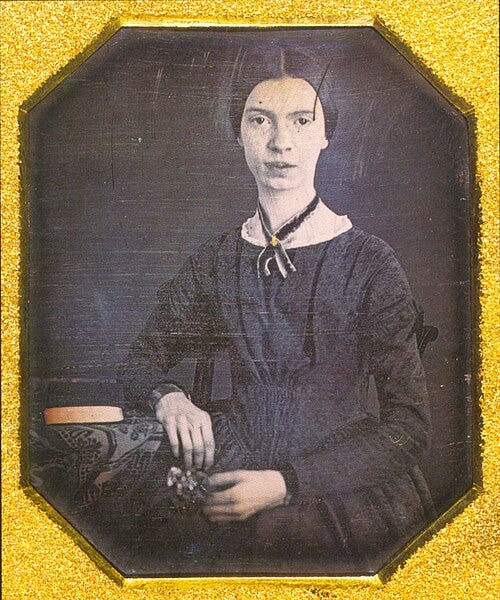
Emily Dickinson Daguerreotype, attribition: Amherst College, CC0, via Wikimedia Commons
A still—Volcano—Life—
That flickered in the night—
When it was dark enough to do
Without erasing sight—

A quiet—Earthquake Style—
Too subtle to suspect
By natures this side Naples—
The North cannot detect

The Solemn—Torrid—Symbol—
The lips that never lie—
Whose hissing Corals part—and shut—
And Cities—ooze away—
(Emily Dickinson, from Fascicle Twenty-four, Fr. 517)
But here I go – I have hardly started and I could get tied up in knots of explication and argument. The Emily Dickinson who wrote that first poem would have laughed and breathed it out in her garden to the butterflies and worm killing birds I think. I’ve not even started on my personal fancies – like seeing her dashes as axles on which her lines turn, and imagining the poems animated like that, like machines turning, articulated, as I unfocused, happy, sometimes sleepy after a few poems. Were I an academic, I might start to wonder at her anticipation of a Derridean uncertainty of meaning. She is clearly a poet fully capable of the best words in the best order and yet also aware of instability in language and shadings of meanings and tone, providing increasingly more optional alternatives to some words in her poems, and maybe that articulation on those axles could slot in variants. Did she become less sure?
I do find resonance between Emily Dickinson’s experience and my own in my own ways, from a bedroom I had to some social withdrawal, possibly also through to possible illness. But it strikes me that maybe many of her admirers feel such – there are so many gaps in what we know of her there is plenty of room to insert our interpretations. Also, perhaps her simplified life and being left to her chores and love of writing may appeal to many. Could I even have been jealous of some of her domestic simplicity – something that certainly resonated with my own during the First Lockdown. Perhaps.
Overall I am enthusing myself again – let me let all my towers collapse – they’ve reigned over my village enough, peace. They needn’t go away I will simply let go of their side and turn again into her sea and, yes, try to complete her before I dare to say anything else that might be taken more seriously.
Maybe if I go back to the first of the loose sheets – and oh I find there also that the spell was broken by the first poem there which I must admit I am not sure I have really ‘gotten’ yet. The fascicles and the early poems in Johnson’s and Franklin’s editions are so lovely, but of course the tone must change and it has. Then too the sheets are not like reading the fascicles that somehow contain, hint at themes, and give reasonable reading chunks. No, in the loose sheets I can go far too far in a sitting, or else not far at all, and feel lost at sea.
I should not measure that. I read of Jim Harrison feeling we should make our way through collections by reading a poem a day and dwelling on it – a good pace (Castanier, 2022). Though I have an impression Emily Dickinson sometimes went faster. There were lots of factors to my pause, maybe as I progressed (and not unusually for me) I dreamt of the end too soon. I’d built too many meanings, maybe reified them too much into essay possibilities (touching on them even here) and also slowed myself by trying to hurry this to reach somewhere. A lesson.
It also strikes me, though there may be reading pros that can digest huge chunks at one time, that maybe it is nicely human to have had to have such a break. These poems are moments (moments that might have taken much more than a moment to write) that dwell within the years of her life. Maybe my pause is telling me that and not to feel, for all I am gathering of her, that I can contain her somehow in my readings – and reach the end and close my book on her.
That makes me suddenly wonder about her own experience of her poems. We often read after her apparently prolific years in the early 1860s that she slowed, perhaps due to an eye issue that led to an extended trip to Boston. I wonder – and yes it is my unacademic question of a moment, which I will now carry with me as I read her – if perhaps she too was digesting what she had done. I think how it can be hard for me to go back to the poems, or to many a book or to my own writing, after a break, as I cannot simply pick up the thread of where I was. So, I wonder if the break in her writing had any such impact for her, measuring herself against such apparent former fluency. I have not read many of her letters and must also read more biographically, so I should be cautious. Many other factors may be relevant. We will all never know so much of this remarkable woman.
With all this wisdom and in a way forgiveness, why not just give myself to her moments again, no pressure, whole worlds to gain. To drift with her again. And again, it may be into Spring. Oh, and yes, also face that I am a bit scared of where she may get to – e.g., possibly less sure and writing less poetry, closer to her death, that topic of fascination to her. Perhaps that is understandable given such insight:
The Heart asks Pleasure – first –
And then – excuse from pain –
And then – those little Anodynes
That deaden suffering –

And then – to go to sleep –
And then – if it should be
The will of its Inquisitor
The privilege to die –
Emily Dickinson (from fascicle Twenty-five, Fr. 588)
Of course, with time came her greater reclusiveness to most and also greater experience of not being grasped by readers. Perhaps there will be illness and what many may see as strange. Or perhaps I will see signs of a person who has made great gains and digested them, lived more in her moments, surely that is our goal. I have much to learn, and I am all curiosity again.
References
Castanier, Bill,. “Author Jim Harrison and a Life Told Through poetry”, in CityPulse 10 March 2022. (https://lansingcitypulse.com/stories/author-jim-harrison-and-a-life-told-through-poetry,19791)
Charyn, Jerome., A Loaded Gun, Emily Dickinson for the 21st Century, 2016, Bellevue Literary Press Eilenberg.
Susan., “Emily v. Mabel”, London Review of Books, Vol. 33 No. 13, 30 June 2011, available behind paywall. https://www.lrb.co.uk/the-paper/v33/n13
Franklin, R. W., The Poems of Emily Dickinson, Readers Edition, 1999, The Belknap Press of Harvard University Press
Gordon, Lyndall., Lives Like Loaded Guns: Emily Dickinson and her Family’s Feuds, 2010, Virago (Chs 1-9)
Johnson, Thomas. H., The Complete Poems of Emily Dickinson, 1961, Little Brown and Company
Keats, John., “Letter to George and Tom Keats, December 21, 27?, 1817”, in Cox, Jeffrey N., Keats’s Poetry and Prose, 2009, W. W. Norton & Co, Inc.
Miller, Cristianne (ed.) Emily Dickinson’s Poems As She Preserved Them, 2016, The Belknap Press of Harvard University Press
Pasternak, Yevgeny., Pasternak, Yelena., Azadovsky, Konstantin. (eds), Letters Summer 1926: Boris Pasternak, Marina Tsvetayeva, Rainer Maria Rilke, 2001, New York Review Books
Rich, Adrienne, “Vesuvius at Home: The Power of Emily Dickinson”, 1975, in Adrienne Rich’s Poetry and Prose, 1993, W. W Norton & Company, Inc